Arthritis in cats is far more common than most owners realize, and far less often diagnosed than it should be. Studies suggest a substantial majority of cats over twelve years old have arthritic changes visible on imaging, yet only a small fraction are ever treated for it. The gap is not caused by inattentive owners. It is caused by the way cats express pain.
A dog with sore joints limps. A cat with sore joints simply stops doing the things that hurt. They stop jumping onto the windowsill, choose a lower sleeping spot, groom a little less thoroughly, and play a little less often. None of that looks like pain. It looks like a cat getting older and settling down, which is exactly how most owners interpret it.
Knowing how to know if your cat has arthritis means learning to read absence rather than presence. The question is not what your cat has started doing but what they have quietly stopped doing. This guide covers the behavioral changes that reveal cat joint pain, why they are so easy to miss, how the condition is assessed, and what treatment can achieve when it starts early.
Table Of Contents
- 1 Why Arthritis in Cats Goes Unrecognized
- 2 Signs of Arthritis in Cats
- 3 Reading the Pattern
- 4 Which Cats Are Most at Risk
- 5 How Arthritis in Cats Is Assessed
- 6 How to Treat Arthritis in Cats
- 7 Adapting the Home
- 8 When to Arrange an Assessment
- 9 Watching for What Your Cat Has Stopped Doing
- 10 Frequently Asked Questions
Why Arthritis in Cats Goes Unrecognized
Cats Adapt Rather Than Complain
Cats are small prey animals as well as predators, and concealing vulnerability is deeply wired into their behavior. A cat in chronic discomfort does not seek help or draw attention. They adjust their environment and their routine until the pain becomes manageable, and they do it so gradually that the adjustment itself becomes the new normal.
This is why arthritis in cats produces so few of the signs owners expect. Limping is uncommon because arthritis in cats is usually bilateral, affecting the same joints on both sides, so there is no good leg to favor. Vocalization is rare. Most cats simply do less, more slowly, from lower heights.
The Damage Is Already Established by Diagnosis
Because the signs are so quiet, most cats are diagnosed well into the disease rather than at its onset. Cartilage loss is not reversible, so treatment that begins late is working against changes that are already permanent.
This is the practical argument for looking early. A cat whose discomfort is recognized when they first stop jumping to the counter has a better outcome than one recognized when they have stopped jumping altogether.
Signs of Arthritis in Cats
Changes in Jumping
This is the single most useful sign, and the one most worth paying attention to.
A cat with early joint pain does not usually stop jumping. They modify how they jump. They may pause noticeably before a leap they used to make without hesitation, gather themselves for longer, or break a single jump into two smaller stages using a chair as an intermediate step. Some begin scrambling on landing rather than landing cleanly.
As the condition progresses, the height they attempt drops. A cat who lived on top of the bookcase moves to the sofa. A cat who slept on the bed starts sleeping on the floor beside it. Owners often interpret this as a change in preference, which is a reasonable assumption and usually the wrong one.
Reduced or Altered Grooming
Grooming requires flexibility. A cat needs to twist the spine and reach the lower back, hips, and tail base, and those are precisely the areas arthritis most commonly affects.
The result is a distinctive pattern: the coat looks well maintained around the head, chest, and front legs, while the lower back and hindquarters become dull, greasy, or matted. Mats forming specifically over the hips or at the tail base are a strong indicator of spinal or hip discomfort rather than general neglect.
Some cats show the opposite pattern and over-groom a specific joint, licking repeatedly at a wrist, elbow, or knee until the fur thins. Focused licking at one location is worth noting.
Litter Box Changes
Using a litter box requires stepping over a raised edge and holding a crouched position. Both are uncomfortable for a cat with hip, knee, or spinal arthritis.
A cat who begins eliminating just outside the box, or who uses it for urination but not defecation, may be avoiding the posture rather than rejecting the box. Owners frequently read this as a behavioral problem and respond accordingly, when the actual issue is that the box has become physically difficult to use.
Switching to a box with one low side often resolves the problem entirely, which is itself diagnostically informative.
Reduced Play and Interaction
Play requires the kind of quick, springing movement that arthritic joints make uncomfortable. A cat who used to chase a toy across the room may now watch it, bat at it from a seated position, or engage briefly and then stop.
Some cats also become less social, not from loss of affection but because reaching a lap requires a jump. A cat who used to sit with you and now settles nearby on the floor may be telling you something about their joints rather than their attachment.
Changes in Temperament
Chronic pain shortens patience. A cat who has become less tolerant of handling, who reacts when stroked along the back or hips, or who has developed a tendency to move away from contact may be responding to discomfort rather than becoming aloof with age.
Sudden irritability in a previously easygoing older cat deserves consideration as a pain sign before it is accepted as a personality change.
Changes in Sleeping Position and Location
Cats with joint pain often shift where and how they sleep. They may choose warmer spots, as heat eases stiffness. They may move to ground level. They may take longer to settle, changing position repeatedly before finding one that works, or appear stiff for the first minute after rising.
That initial stiffness after rest, easing as the cat moves, is a classic arthritic pattern and one of the more reliable signs when owners know to watch for it.
Reading the Pattern
The table below sets out the common signs alongside how they are typically misread, which is where most missed diagnoses happen.
What You Notice |
Common Assumption |
What It May Actually Mean |
| Stopped jumping to high surfaces | Slowing down with age | Jumping has become painful |
| Two-stage jumps or hesitation before leaping | Just being cautious | Joint pain on take-off or landing |
| Matted or dull fur over lower back and hips | Poor grooming in old age | Cannot twist to reach those areas |
| Eliminating beside the litter box | Behavioral problem | Stepping in or crouching hurts |
| Less playful, watches instead of chasing | Losing interest in play | Quick movement is uncomfortable |
| Reacts when stroked along the back | Becoming grumpy | Touch over sore joints causes pain |
| Sleeping on the floor instead of the bed | Changed preference | Cannot reach the height comfortably |
| Stiff for a minute after waking | Normal for an old cat | Classic arthritic stiffness after rest |
The recurring theme is that nearly every sign of arthritis in cats has a plausible innocent explanation, and the innocent explanation is usually the one owners reach for. Considering pain as an alternative is what closes the diagnostic gap.
Which Cats Are Most at Risk
- Cats over ten years of age carry substantially elevated risk, with prevalence rising sharply through the teenage years.
- Overweight cats place greater mechanical load on their joints and tend to develop symptoms earlier and more severely than cats at a healthy weight.
- Cats with previous joint injuries or fractures often develop arthritis in the affected joint years after the original injury has healed.
- Certain breeds carry inherited predispositions, including Maine Coons for hip dysplasia and Scottish Folds for a cartilage condition affecting multiple joints.
- Cats with chronic kidney disease frequently have concurrent arthritis, and the combination affects which treatments are appropriate.
How Arthritis in Cats Is Assessed

Why Owner Observation Matters Most
An arthritic cat in a consultation room is a cat who is frightened, still, and hiding. They will not demonstrate the hesitation before jumping or the stiffness after rest that reveals the condition at home. This makes owner observation genuinely central to diagnosis rather than supplementary to it.
The most useful thing an owner can bring to an appointment is specific detail: which surfaces the cat has stopped using, when the change began, whether it developed gradually or suddenly, and what the cat could do a year ago that they cannot do now. Short phone videos of the cat moving around the home, jumping, or using the litter box are more informative than any description.
Examination and Imaging
A veterinarian assesses joints for thickening, reduced range of motion, and pain response, and observes posture and movement where the cat will allow it. Radiographs can confirm arthritic changes, though it is worth knowing that the correlation between what appears on imaging and how much pain a cat is in is imperfect. Cats with dramatic changes on film may cope well, while cats with modest changes may be significantly uncomfortable.
Bloodwork is usually run alongside, both to rule out other conditions producing similar signs and to establish kidney and liver function before starting medication. Comprehensive diagnostics and bloodwork covering kidney function, liver health, and thyroid levels allow this to be assessed in one panel.
The Value of Assessment at Home
Watching a cat move through their own environment provides information that no clinic examination can replicate. A veterinarian can see the cat’s actual jumping heights, observe how they approach the litter box, note which surfaces they use and which they avoid, and assess whether the home is contributing to their difficulty.
The cat is also relaxed enough to be examined properly, which matters for a condition assessed largely through palpation and movement. The broader case for evaluating cats in their own environment is covered in the guide on benefits of at-home vet services for anxious pets and busy owners.
How to Treat Arthritis in Cats
Solensia Monthly Injections
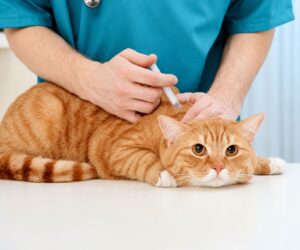
Solensia is a monthly injection developed specifically for cats. It works by targeting nerve growth factor, a protein that amplifies pain signals from arthritic joints, and neutralizing it before it reaches pain receptors.
Its practical advantages for cats are considerable. It is given once monthly by a veterinarian rather than daily by the owner, which removes the difficulty of medicating a cat orally every day. It avoids the kidney and gastrointestinal concerns associated with long-term anti-inflammatory use, making it suitable for cats with chronic kidney disease who previously had few good options. Many owners report their cat jumping to surfaces they had abandoned within weeks of starting.
Comfort Paws offers Solensia injections as part of an at-home arthritis care plan, meaning the monthly dose is given in the cat’s own home rather than requiring a clinic visit each month.
Pain Medication
Anti-inflammatory medication is used in cats but requires more caution than in dogs. Feline metabolism handles these drugs differently, kidney function must be assessed before starting and monitored during use, and dosing is conservative. Some cats do well on them. Others, particularly those with kidney disease, are better served by alternatives.
Other pain medications are sometimes added for cats whose discomfort is not fully controlled, particularly where nerve-related pain is contributing.
Joint Supplements
Glucosamine, chondroitin, and omega-3 fatty acids support joint health and have mild anti-inflammatory effects. They work slowly and modestly rather than dramatically, and are best understood as one component of a plan rather than a treatment on their own. Omega-3 supplementation in particular has reasonable evidence behind it in cats.
Weight Management
For an overweight arthritic cat, weight reduction is among the most effective interventions available. Every reduction in body weight reduces the load carried by damaged joints.
The important caveat is that weight loss in cats must be gradual. Rapid loss carries a serious risk of hepatic lipidosis, a liver condition that develops when the body mobilizes fat too quickly. This is not a situation for owner-managed crash dieting. A veterinarian will set a safe rate and a feeding plan to achieve it over months.
Adapting the Home
Environmental changes often produce the most immediately visible improvement, because they remove the specific obstacles a cat has been struggling with.
Difficulty |
Practical Change |
| Cannot jump to favorite high spots | Add a footstool or step as an intermediate stage |
| Struggling to enter the litter box | Switch to a box with one low cut-down side |
| Avoiding stairs to reach resources | Place food, water, and a litter box on each level |
| Stiff and cold on waking | Provide warm, draught-free bedding at floor level |
| Slipping on hard floors | Add rugs or runners along routes the cat uses |
| Difficulty lowering head to eat | Raise food and water bowls slightly |
These adjustments are inexpensive and reversible, and the cat’s response to them is informative. A cat who immediately begins using a low-sided litter box after months of accidents has effectively confirmed that the problem was physical.
Ongoing monitoring through wellness examinations allows treatment to be adjusted as the condition changes, and fits alongside the broader senior monitoring described in the guide on senior cat wellness exams and early disease detection.
When to Arrange an Assessment
Any sustained change in how a cat moves, grooms, or uses their environment is worth raising. The following warrant a prompt appointment rather than waiting:
- A cat who has stopped jumping entirely or can no longer reach places they used until recently, indicating the condition has progressed significantly.
- Reluctance to bear weight on a limb, or a limp that has appeared suddenly, which may indicate injury rather than chronic arthritis.
- Mats forming over the hindquarters in a cat who was previously well groomed, showing they can no longer reach those areas.
- Litter box avoidance that has developed alongside other mobility changes, which is often the point at which quality of life is meaningfully affected.
- A cat who has become reactive to being touched or handled where they were previously tolerant.
A sick visit allows examination, assessment, and sample collection to happen in a single appointment.
Watching for What Your Cat Has Stopped Doing
Arthritis is one of the conditions where owners hold the most useful information and are least aware that they hold it. The height your cat used to jump to, the way they used to land, where they used to sleep, how their coat used to look across the lower back: all of that is diagnostic detail, and none of it appears in a consultation room.
If your cat has been jumping less, grooming unevenly, or settling somewhere new, those changes deserve consideration as pain rather than acceptance as age. Treatment is more effective the earlier it begins, and cats frequently regain activities their owners assumed were gone for good.
Comfort Paws Veterinary Care provides at-home arthritis assessments and monthly Solensia injections in Brooklyn, allowing your cat to be evaluated where they actually live and move. Reach out to schedule a consultation to discuss what you have been noticing.
Frequently Asked Questions
Q: How to know if your cat has arthritis at home?
A: Watch for what your cat has stopped doing. Reduced jumping, hesitation before leaping, matted fur over the lower back, litter box accidents, and stiffness after rest are the most reliable indicators of cat joint pain.
Q: Do cats with arthritis limp?
A: Usually not. Arthritis in cats typically affects the same joints on both sides, so there is no unaffected leg to favor. Cats show pain by reducing activity and avoiding height rather than by limping visibly.
Q: How to treat arthritis in cats effectively?
A: Treatment combines monthly Solensia injections, appropriate pain medication where suitable, joint supplements, gradual weight management, and practical home adjustments. Most cats respond best to several approaches together rather than any single intervention.
Q: Can arthritis in cats be cured?
A: No. Cartilage loss is permanent, so treatment manages pain and slows progression rather than reversing damage. Cats often regain considerable activity with good management, but the underlying joint changes remain.
Q: Is my cat too old for arthritis treatment?
A: Age alone rarely rules out treatment. Options exist for cats with kidney disease and other age-related conditions, including Solensia, which avoids the organ concerns associated with long-term anti-inflammatory use in older cats.